AI Automation for Small Business: What Actually Works (From Someone Who Ships It)
AI automation for small business isn't hype when you scope it to one painful, repetitive task. Here are the automations that save real hours, the ones to skip, and how I build them in production.

AI automation for small business works best when you stop thinking about "AI" and start thinking about one task you hate doing every day. The job that eats your afternoon. The reply you type fifty times a week. The spreadsheet you update by hand. Automate that one thing well and you get hours back without touching anything else.
I build this for a living. Not as slide decks — in production. I run my own AI automation SaaS, FlowMaticX, and a real Dubai real-estate firm (Armela) runs on it today, qualifying leads in English and Arabic — the platform itself supports 10 languages. So when I tell you what's worth automating and what's a waste of money, it's from shipping the thing and keeping it running, not from a webinar.
What AI automation for small business actually means
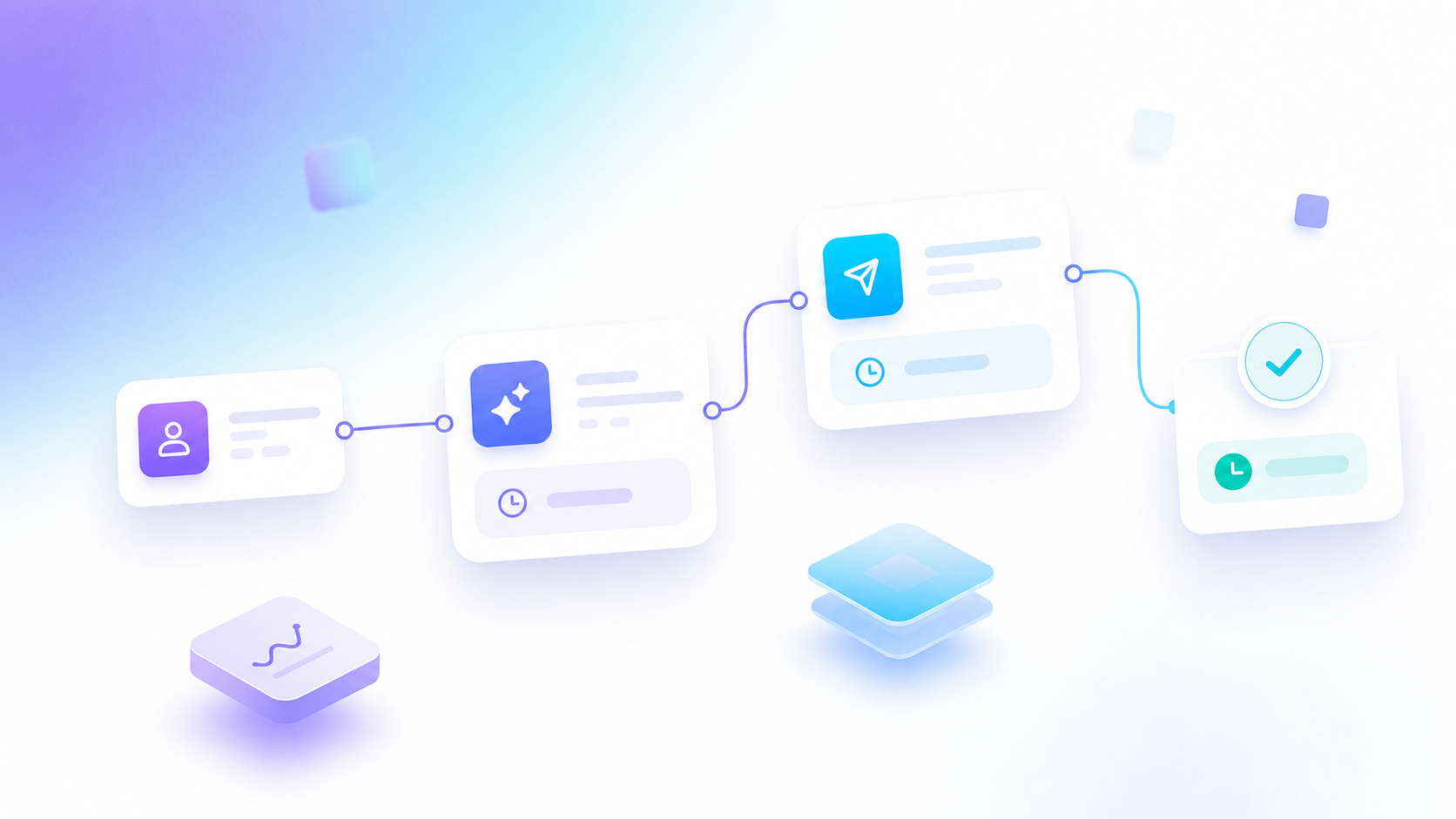
Forget the robot-takes-your-job framing. For a small business, AI automation is three plain things working together:
- A trigger — a new lead, an inbound message, a form submission, a date.
- A decision — classify it, draft a reply, pull the right data, decide what happens next. This is where the AI earns its keep.
- An action — send the message, update the CRM, book the slot, flag a human.
Most "automation" tools have done triggers and actions for years. What changed is the middle. A language model can now read a messy customer email and respond like a competent staff member instead of a rigid keyword bot. That's the real shift. Used on the right task, it turns a fragile rule-based flow into something that actually handles real-world mess.
The automations worth your money (in priority order)
I rank these by payback, not by how impressive they sound in a demo.
- Lead reply and qualification. An AI chatbot that answers inbound enquiries instantly, qualifies the lead, and books a call or hands off to you. This is the single highest-ROI automation for most small businesses. On FlowMaticX, Armela's chatbot holds first-touch conversations in English and Arabic so leads don't go cold waiting for office hours. Speed-to-first-reply is the whole game in sales.
- Customer support deflection. A bot trained on your FAQs, policies, and order data that resolves the repetitive majority — often well over half of tickets — "where's my order", "what are your hours", "do you do X" — and escalates the rest with context attached. You stop drowning in tickets that never needed a human.
- Quote and proposal drafting. Feed it the enquiry, it drafts a first-pass quote or proposal you edit in two minutes instead of twenty.
- Data entry and CRM hygiene. Parse emails and forms, extract the structured fields, write them to your CRM. Boring, invisible, and it claws back hours every week.
- Content and listing updates. On MenuPriceToday I run daily automated updates across 657 menu items in 16 countries. No human retypes prices. The pipeline fetches, validates, and publishes on its own — that's automation doing the dull work at a scale a person can't match.
The ones to skip (for now)
I'll save you some money. These sound great and usually disappoint at small-business scale:
- "AI that runs your whole business." No. Automate one workflow, prove it, then expand. Big-bang automation projects fail.
- Fully autonomous outbound that nobody reviews. AI writing and sending cold emails unsupervised is a reputation risk. Keep a human in the loop until you trust the output.
- Generic chatbot widgets bolted on with zero training. A bot that doesn't know your products or policies frustrates customers faster than no bot at all.
- Automating a broken process. If the workflow is a mess by hand, automating it just makes the mess faster. Fix the process first.
Build vs buy vs custom: a quick comparison
| Approach | Best for | Cost | Trade-off |
|---|---|---|---|
| Off-the-shelf SaaS (e.g. a hosted chatbot tool) | Standard FAQ deflection, fast start | Low monthly | Limited logic, your data lives elsewhere, hard to customize |
| No-code automation (Zapier/Make + an LLM) | Simple trigger→AI→action flows | Low–medium | Gets fragile and pricey as logic grows; debugging is painful |
| Custom-built automation / SaaS | Anything tied to your real data, multi-step logic, scale | Higher upfront | Needs an engineer — but you own it and it doesn't break under load |
My honest take: start no-code to validate the idea cheaply. The moment a flow becomes core to revenue — lead handling, support, anything customers touch — move it to something built properly. No-code tools are wonderful until your business depends on them, then every edge case becomes a 2am fire. FlowMaticX exists because I needed automation that holds up in production, not a Zapier chain held together with hope.
How I build automation that survives contact with real customers
A few principles I won't compromise on, learned from running live systems:
- Scope to one workflow. One trigger, one clear outcome. Ship it, measure it, then add the next.
- Keep a human escape hatch. When the AI isn't confident, it hands off with full context. Always.
- Log everything. You can't improve what you can't see. Every conversation and decision gets recorded so we tune from real data.
- Build on reliable infrastructure. The flashy AI part fails quietly if hosting is shaky. I run my own stack (cPanel/WHMCS via WaseerHost) so uptime isn't an afterthought — it's the floor everything stands on.
Performance matters too. On KandyLover I cut load time roughly 25–30% (LCP from 3.5s to 1.8s). A fast, reliable surface is what makes an automation feel trustworthy instead of clunky. You can see more of our work across these builds.
Where to start this week
Pick the task that costs you the most repeated hours. For most small businesses that's responding to leads or answering the same support questions. Map the trigger, the decision, and the action on a single sheet of paper. If you can describe it in three lines, it's automatable — and it's probably the cheapest hour you'll ever buy back.
If you'd rather not figure out the build yourself, that's exactly what I do. I'll run a free automation audit of your business, find the one or two workflows with real payback, and tell you honestly whether to buy something off the shelf or build it. No pressure, no jargon. Book a free call and let's find the hours hiding in your week — whether that's an AI chatbot, a custom automation, or a SaaS built to run your operation.
Frequently Asked Questions
How much does AI automation for a small business cost?
It ranges widely. A hosted chatbot tool can be tens of dollars a month, while a custom-built automation tied to your real data is a higher one-time build that you then own. The smart move is to start cheap to validate one workflow, then invest in a proper build only for the flows that touch revenue. A short audit tells you which path fits before you spend anything.
What's the best first automation to set up?
Lead reply and qualification, almost always. An AI chatbot that answers enquiries instantly and books the call has the fastest payback because speed-to-first-reply directly affects how many leads you close. Customer support deflection is a close second if you're buried in repetitive tickets.
Will AI automation replace my staff?
No — it removes the repetitive work they shouldn't be doing in the first place. Good automation handles the high-volume, low-judgment tasks and hands anything complex to a human with full context. Your team spends time on the work that actually needs them.
Do I need a developer, or can I use no-code tools?
Start with no-code to test an idea cheaply. But once an automation becomes core to your business, no-code chains get fragile and expensive to maintain. At that point a custom build is more reliable and you own it outright. I build production systems for exactly this reason.
How do I know if a workflow is worth automating?
If you can describe it as a trigger, a decision, and an action in three lines — and you repeat it often — it's a strong candidate. If the process is broken or inconsistent by hand, fix that first, because automating a mess just makes it faster. A free audit will rank your workflows by payback so you start with the biggest win.
Want this built for your business?